

Homes for Sale in Prairie Grove, AR
Prairie Grove sits west of Fayetteville in Washington County, and for a lot of buyers, its appeal is pretty easy to understand.
You can live in a smaller community with its own schools, parks, local businesses, historic downtown, and a surprising amount of preserved open space while still being close enough to Fayetteville for work, restaurants, Razorback games, shopping, and everything else the larger city offers.
That's a combination that's becoming increasingly difficult to find as Northwest Arkansas grows.
Prairie Grove isn't rural in the way it once was. New neighborhoods and residential development have changed the city significantly over the last decade, and that growth is continuing.
But it still feels noticeably different from Fayetteville.
For someone looking at homes for sale in Prairie Grove, the question is usually whether that tradeoff — a little more driving in exchange for a smaller-town environment and potentially more space — fits the lifestyle they're trying to create.
Prairie Grove Still Feels Like Its Own Town
One of the things I like about Prairie Grove is that it doesn't simply feel like another Fayetteville subdivision with a different mailing address.
It has its own identity.
There's a small historic downtown, local businesses, schools, parks, youth sports, a library, an aquatic park, community events, and neighborhoods that have been here for generations.
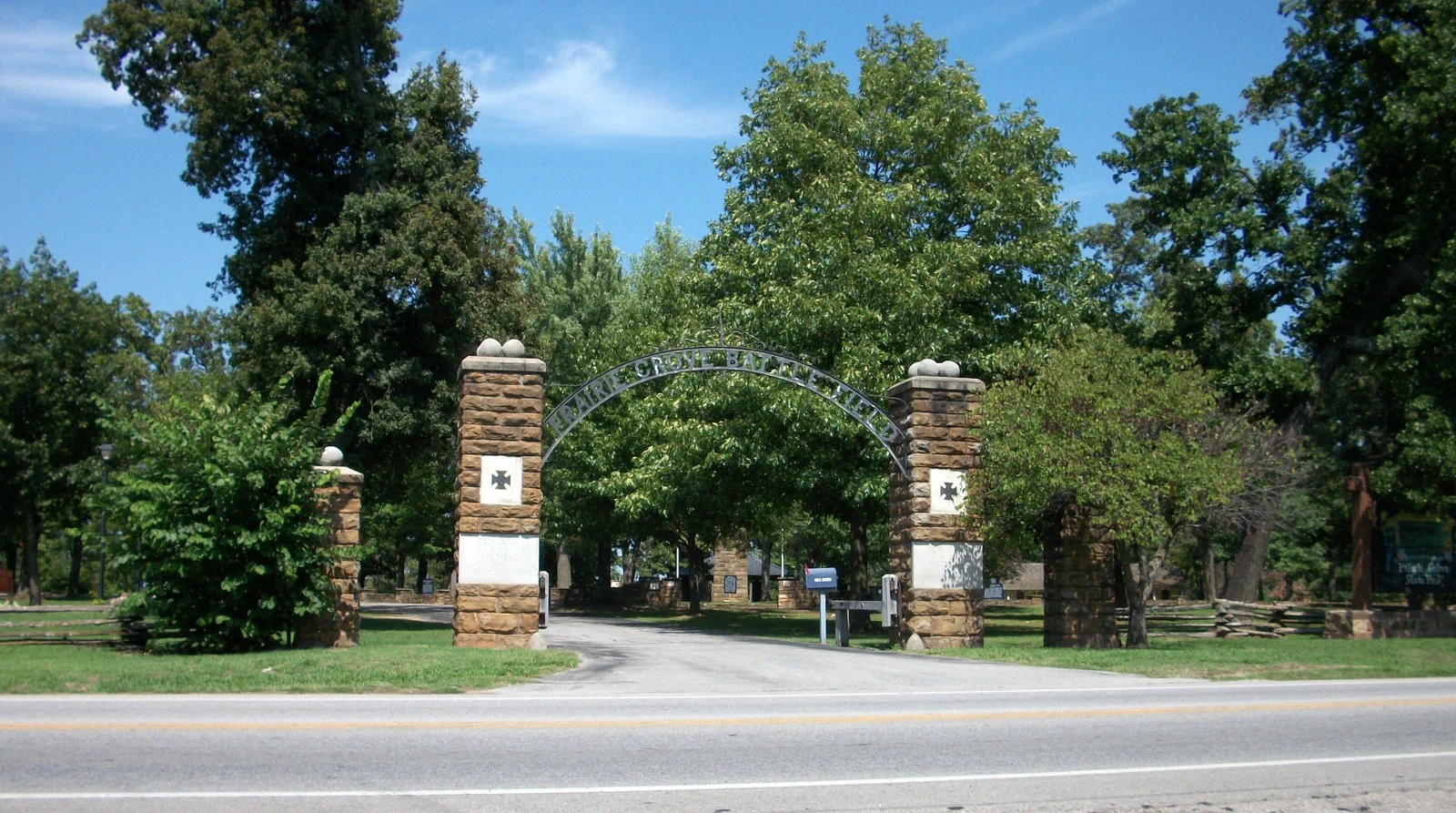
And right in the middle of town is one of the most historically significant pieces of preserved land in Northwest Arkansas.
That combination gives Prairie Grove more of a traditional small-town feel than some of the rapidly developing communities elsewhere in the region.
At the same time, Fayetteville is close enough that you don't have to give up access to a larger city.
For a lot of people moving here, that's the sweet spot.
Prairie Grove Battlefield State Park Is a Huge Part of the Community
You really can't talk about Prairie Grove without talking about the battlefield.
Prairie Grove Battlefield State Park preserves the site of the Battle of Prairie Grove, fought on December 7, 1862. It was the last major Civil War engagement in Northwest Arkansas.
Today, the park preserves a large area of open fields, historic structures, mature trees, and battlefield land right in the city.
There are walking areas, a driving tour, museum exhibits, picnic areas, historic buildings, and events throughout the year.
The park also hosts the Clothesline Fair over Labor Day weekend and a large Civil War reenactment on scheduled years.
Even if you're not particularly interested in Civil War history, having that amount of preserved green space in the middle of a growing community is significant.
It gives Prairie Grove a visual character that's very different from a city built almost entirely around newer residential development.
Prairie Grove Has More Parks and Recreation Than You Might Expect
The battlefield isn't the only outdoor space in town.
Prairie Grove has invested quite a bit in local recreation.
Delford Rieff Park includes baseball facilities, a walking track, sand volleyball, a skate park, and the Prairie Grove Aquatic Park.
Muddy Fork Park provides additional space for soccer, walking trails, and a dog park.
There's also Mock Park near downtown, which hosts the Prairie Grove Farmers Market during the warmer months.
For a relatively small community, that's a pretty solid collection of everyday recreational amenities.
And because Fayetteville is nearby, you're also within driving distance of the Razorback Greenway, Kessler Mountain, Lake Fayetteville, Mount Sequoyah, and the broader Northwest Arkansas trail system.
What Are Homes Like in Prairie Grove, AR?
Prairie Grove has a broader housing mix than someone unfamiliar with the area might expect.
Closer to the older parts of town, you'll find established neighborhoods, traditional homes, older properties, and houses with mature trees.
Then there are newer subdivisions and new construction that have been added as the city has grown.
Move toward the edges of town and the landscape starts changing again.
That's where you can find larger lots, rural homes, acreage, shops, barns, pasture, and properties that feel considerably more like the country.
That variety is one of Prairie Grove's strengths.
You can potentially live in a neighborhood close to schools and parks, buy a newer home on the edge of town, or start looking outside the city for several acres.
All three properties might have a Prairie Grove address.
But they would give you completely different lifestyles.
Prairie Grove Has Been Growing Quickly
This is something buyers need to understand.
Prairie Grove may still feel like a small town, but it isn't standing still.
Northwest Arkansas's growth has been pushing outward from Fayetteville, and Prairie Grove is one of the communities absorbing some of that expansion.
New subdivisions have added housing, more people are commuting between Prairie Grove and Fayetteville, and undeveloped land around the city continues attracting attention.
That means you shouldn't assume that the empty field behind a house will always be an empty field.
If the setting around a property is part of why you love it, we'll want to investigate what's happening nearby.
What's the land zoned for?
Are there development plans?
Where could additional roads go?
What other neighborhoods are being built?
Growth isn't necessarily a negative.
But you should know what you're buying into.
How Is the Commute From Prairie Grove to Fayetteville?
This is probably one of the most important questions for someone relocating here.
Prairie Grove sits west of Fayetteville, with Highway 62 providing the primary connection between the communities.
If you work in Fayetteville, living in Prairie Grove can absolutely make sense.
But where in Fayetteville you need to go matters.
Working on the west side of Fayetteville is different from driving across town every morning to the east side.
And like everywhere else in Northwest Arkansas, traffic during commuting hours can make a route feel very different than it does on a Sunday afternoon.
That's why I recommend actually driving it.
If you're considering a house in Prairie Grove and you'll be commuting five days a week, get in the car one morning and drive from that neighborhood to your office.
Don't make a home-buying decision based solely on what Google Maps says when you're sitting on the couch at 9:00 at night.
Prairie Grove vs. Farmington
This is probably the most useful comparison for a lot of buyers.
Farmington is immediately west of Fayetteville and has increasingly become connected to the Fayetteville side of the metro.
Prairie Grove is farther west and still feels more like a separate small town.
That difference affects the lifestyle.
If minimizing your drive into Fayetteville is the priority, Farmington may make more sense.
If you're willing to go a little farther west because you prefer Prairie Grove's small-town environment or because the housing options there fit what you're looking for, Prairie Grove becomes more interesting.
And if you're looking for acreage, we may end up comparing rural properties surrounding both communities.
This isn't really about one being better than the other.
It's about how far outside Fayetteville you want to live and what you want in return for that additional distance.
Prairie Grove vs. Fayetteville
These are obviously very different communities.
Fayetteville gives you the University of Arkansas, Razorback athletics, restaurants, nightlife, trails, live music, downtown, Dickson Street, healthcare, and a much larger employment base.
Prairie Grove gives you a smaller community with less traffic, a different pace, more rural surroundings, and potentially different housing and land options.
But you don't necessarily have to choose one lifestyle and completely give up the other.
That's part of Prairie Grove's appeal.
You can live in Prairie Grove and still drive into Fayetteville for a Razorback game, dinner, work, or entertainment.
Then you can drive back home to a considerably smaller community.
For some people, that's exactly what they want.
For others, making that drive regularly will convince them they'd rather live in Fayetteville.
That's something I'd rather help you figure out before we start writing offers.
If You Want Acreage, Look Beyond the Subdivisions
Prairie Grove has historically been surrounded by agricultural land, and once you move outside the more developed parts of town, that rural landscape becomes obvious pretty quickly.
For buyers looking for acreage, that opens up possibilities.
Depending on what's available, you may find properties with pasture, wooded land, shops, barns, room for animals, or simply enough space that you don't feel like you're living on top of your neighbors.
But buying acreage is different from buying a house in a subdivision.
We'll want to investigate the water source, septic system, surveys, easements, road access, drainage, fencing, outbuildings, internet service, deed restrictions, and whether the property is inside or outside city limits.
If you're buying land because you want horses, chickens, a shop, an RV, or some other specific use, we'll verify that the property actually works for that plan.
The goal isn't just to buy more land.
It's to buy land you can actually use the way you intend to.
What About Schools in Prairie Grove?
Prairie Grove has its own public school district, which plays a significant role in the community.
Schools, athletics, youth sports, and school activities are a big part of life in a smaller community like this.
If schools are important to your move, though, we'll verify the current district and attendance information for the exact property you're considering.
That's particularly important when looking at rural properties outside the main part of town.
A Prairie Grove mailing address doesn't necessarily tell you everything you need to know about a property's location or school assignment.
Prairie Grove Is Small — But You Don't Have to Leave Town for Everything
Prairie Grove isn't Fayetteville, and I'm not going to pretend it has the same level of restaurants, shopping, or entertainment.
It doesn't.
But it's also not just a collection of houses surrounded by farmland.
You've got grocery and everyday shopping options, local restaurants and businesses, parks, schools, the aquatic park, library, farmers market, youth sports, and community events.
For everything else, Fayetteville and Farmington are nearby.
That makes Prairie Grove different from living much farther out in rural Northwest Arkansas.
You're getting some separation from the main metro without completely disconnecting from it.
Is Prairie Grove a Good Place to Live?
That depends on why you're considering it.
If you want to walk to restaurants and nightlife, have immediate interstate access, or be five minutes from the University of Arkansas, Prairie Grove probably isn't where I'd start your search.
But if you're looking for a smaller community, want to stay reasonably close to Fayetteville, prefer a little more separation from the busiest parts of Northwest Arkansas, or want to explore properties with larger lots or acreage, Prairie Grove makes a lot of sense to consider.
The biggest question is probably:
How far outside Fayetteville are you willing to live, and what do you want to gain by moving farther out?
If the answer is more space, a smaller community, less congestion, or a property you simply can't find closer to town, Prairie Grove may be worth the extra drive.
Buying a Home in Prairie Grove, Arkansas
I've been selling real estate throughout Northwest Arkansas for more than 10 years and have helped hundreds of families buy, sell, and relocate throughout the region.
When I'm helping someone evaluate a home in Prairie Grove, I'm not relying on an automated home-value estimate to tell us what it's worth.
I look at what's actually selling, how comparable those properties really are, neighborhood differences, the age and condition of the home, lot characteristics, updates, days on market, price reductions, and competition from new construction.
That's particularly important in a growing community like Prairie Grove.
An established home near the center of town, a brand-new house in a developing subdivision, and a home on five acres outside the city aren't competing in exactly the same way.
And once we're evaluating acreage, the analysis becomes even more property-specific.
Land, shops, barns, fencing, ponds, outbuildings, road access, utilities, surrounding development, and other improvements can all affect value in ways an automated estimate can't properly understand.
If you're relocating to Northwest Arkansas, I'll also help you compare Prairie Grove with Farmington, Fayetteville, Tontitown, and other communities that might fit your budget and lifestyle.
The goal isn't to convince you to live in Prairie Grove.
It's to help you understand Prairie Grove well enough to decide whether being a little farther outside Fayetteville gives you more of the life you're actually moving to Northwest Arkansas to create.
If you're considering homes for sale in Prairie Grove, AR, or you're still trying to figure out which Northwest Arkansas community fits you best, reach out and let's talk about what you're looking for.